M18 Carry Tierlist
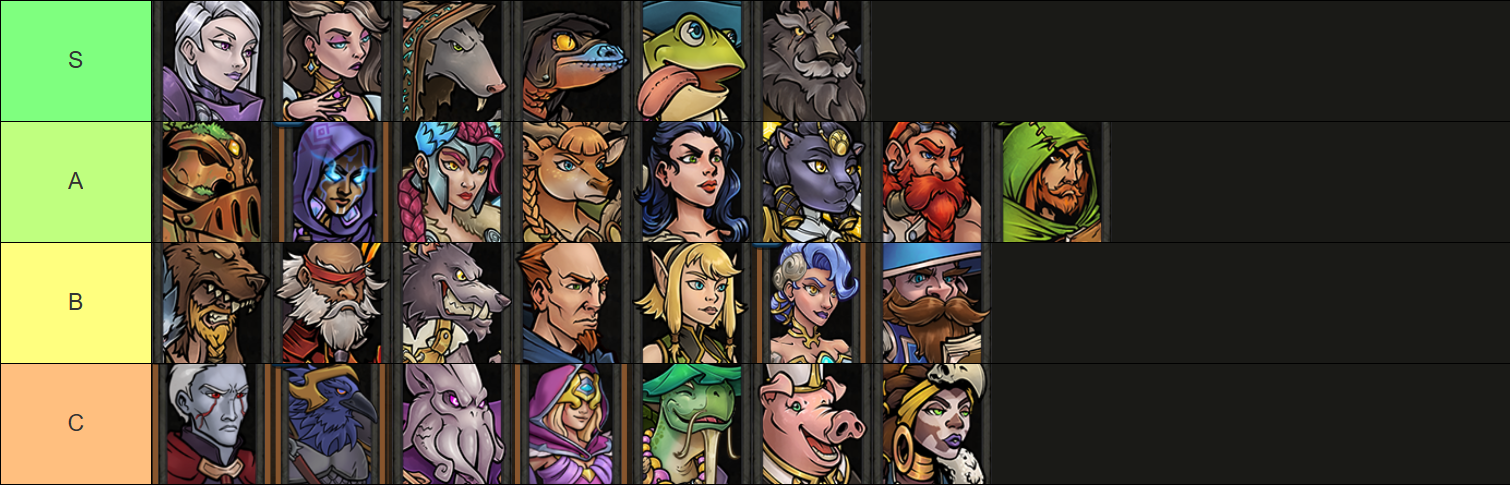
This list is created with the assumption that we are playing on Max Madness, and doing what is generally considered “meta play,” which is to say 1 Carry, 3 supports. This list is not a metric of viability; it is a metric of accessibility. All heroes are viable and playable on all difficulties with enough work, but some simply need more than others to function. Thus, the Tierlist stops at C tier because even C’s can clear a run with enough love. This list is exclusively to compare the heroes to each other’s performance by looking at their level up rewards and card pools. Deck building in Act 1 is extremely important, and characters with strong Act 1 decks are often prioritized over ones with strong endgame decks. At max Madness, Rares cannot be purchased in Act 1, and only one uncommon can be purchased in shops. Divinations are often leveraged in bulk to find multiple copies of key cards, and some harder to operate Carries will sometimes restart a run to get better divination results. Due to a Carry’s reliance on typal density, Multiclass heroes often struggle a lot more than single-class heroes in the Carry position. A hero with a smaller card pool will be more likely to see relevant cards in a divination, and the 4th card seen in divinations seldom makes up the difference. A large amount of our perk points are spent on Gold and Shards, severely limiting the number of perk points we can spend, compared to lower Madness Levels.
Carries are generally assumed to be receiving Bulk Bless from Supports, therefore heroes receive relatively little credit for self-applied buffs that an optimized support shell can already provide. In these teams, going before enemies is critical, even if not OTKing, and combats often move quite fast. Removing an enemy on turn one is usually expected, and by act 4, a well-built deck should be capable of ending an ordinary combat by turn 2. Unlike the lower Madness Tierlists, some amount of familiarity with the game is expected, and is therefore not considered when creating the list. At high Madness, the best Carry is not the Hero that can generate the best resources, but instead the one who can convert three supports worth of resources into dead enemies the most efficiently, while requiring the least painful route to get there.
This list makes zero claims on the capabilities of heroes as a Support. Please look at the Support list for that breakdown.
-
Hatred well and truly blows every other talent in the game out of the water for damage output, being accessible even in the first combat, and providing an unmatched damage source throughout the entire game. Her opening deck could use a bit of work, but Hatred turns just about any damage source into a powerhouse, and so rolling divinations always nets strong spells. Although her other talents don’t keep up, they are still exceptionally strong, and even without being combined with the strong obvious weapons like Ice Breaker, Navalea cleans house without failure.
-
Gustav is premium Sharp Carry for scouts, I consider Power Slave to be top 3 starting cards, and starting with multiple Zero Costs and Chant of Accuracy makes his Act 1 exceptional. Heavy Metal doesn't perform as well as it could until level 3, where Shrill Tone is taken, and the game is well and truly over from there.
-
Thuls can struggle a bit out the gate, and has some reliance on good RNG from divinations to make a deck that functions well, but Killer Instinct and Black talons more than make up for it. Black Talons is firmly in the top 5 best level up rewards, giving double hits in a relevant damage type, with relevant Curses. Poison is mostly irrelevant at higher madness, but that doesn’t make Thuls bad. His levels 3, 4 and 5 are also quite decent, though all pale in comparison to Black Talons.
-
Although considered very bad in Low Madness, with a bit of mental shift, he can perform much better. Nenukil is often built around his Reload mechanics and Speed stacking, but this is largely unecessary for a scout Carry. Players often see this giant Rube Goldberg machine and presume it must be the intended offensive engine. The reality is he performs much better when simply treated as a scout with a good card pool, and above average talents. Loaded Gun is simply 2 free energy every turn, Gunpowder is a Flat 20% damage increase to all melee attacks, and Ranged/Melee weaving is not necessary. Double Barrel and Fast and Furious give access to Fury beyond normal limits, and the scout pool is just primed for a solid end game Carry deck utilising Scavenge and Ambidextrous.
-
Famous for his blocking, but shockingly better in the carry position than most would believe. Heat laser is extremely strong as a carry due to its cheap cost and AoE, and the starting block/fortify make for a more convenient carry. He almost exclusively plays Fire/Blunt and is often seen with Volcanic Axe to transform high performing cards like whirlwind to the correct type. Heiner can have a hard time getting off the ground compared to other heroes, and this brings him down a tier, but his end game is exceedingly easy to achieve and use. A very consistent way to get clears.
-
Sigrun has a hard time getting off the floor, with very little to go off in her starting deck. Her talents are whacky to pilot, asking for a mix of Attack and Spell Cards, and assigning Perks for her can be confusing. But when Sigrun gets going with Storm Channeler and good wet application, she can Bring the Roof Down. She can struggle a little with speed manipulation due to her starting item, but this can be managed. Valhalla is also free-mode for most carries, and she is hardly an exception.
-
The Andrin Rework gave him several useful tools and places him comfortably among the stronger carries. His starting deck often keeps 7 or 8 cards, and replaces the rest with Sharp application and Good Value damage AoE. He can struggle a little, because he is designed to be self reliant and self perpetuating, which is not condusive to a sort of Support->Carry Dynamic and Mark falls prey to inaccessibility and the Restricted Power Corruptor. A very balanced carry.
-
Similar to Bree, Yogger struggles massively in the first act. His starting deck is much more suited to a support role, and his level ups tend to contribute next to nothing when put beside the other Warriors. Yogger Carry decks often rely on Highrolled Act 1’s, and using his meats and healing to contribute over longer rounds. His end game is good due to ease of access of Fury, and Gourmet Meats are able to apply large amounts of bless, but it is not particularly noteworthy method of applying buffs.
-
Bleed damage is a fairly obvious trap at higher madness, being mostly unworkable as a Main Damage Vehicle, which leaves him to lean on the bleed application in other creative ways. Vampiric Frenzy can certainly push out huge amounts of damage, and leftover bleed is still a perfectly acceptable way to eek out a bit of extra damage. His leech application is decent and can do a fair bit of passive healing, even as a carry, making him quite a good Carry in slower comps or early game teams that can struggle to find healing. Failing that, the normal methods of scaling damage are basically lost on him, and aside from a decently sized resistance shred at level 3, his damage builds are a bit hard to work with in no small part due to card pool dilution. Velarion is best left as a pure support, or a split damage support.
-
Although seemingly worse than the other healers, a triple Dawnlight opener makes for an easier Act 1, by playing into holy, and then pivoting somewhere down the line, with Gustav Sharp Mind lines, or Fire Fortify lines with Heiner/Magnus. Her talents are primed to do good damage with plenty of multi hits, good control over targeting, and high burst. Still suffers from the rough Healer pool of cards, but is far more reliable than most healers.
-
Reginald Holy decks are a small step above Ottis, due to Reginald’s self-reliance with bless application; though we generally prefer to apply buffs to other heroes, if anyone can break that format, it could be him. His talents are mostly decent, especially when leaning on Divine Retribution through the early acts. Reginald is often used as a strong carry in the lower madness levels, but his strengths don't shine anywhere near as much at higher madness due to the power level of cards like Divine Power, and that makes him an acceptable carry.
-
Lightning is tough to make work throughout the game due to limited access to cheap AoE Spells. Spark is the worst of the three elements in mage, and Wilbur’s Talents seldom make up for these issues. If you're looking for a strong Lightning carry, just pick Evelyn, Sigrun or Navalea, they will perform better almost every time. The only saving grace of Lightning is the exceedingly strong wet perk to reduce resistance, which often pulls Lightning spells far ahead in the early game if you can cast them. Lightning also has permanent reduction through Lightning manual, which can have some very fun late game implications, but is seldom better than Cold Snap.
-
Malukah leans heavily on a Fade/Unholy Storm opener to get through act 1, while getting Sharp donated. Although Malediction is exactly the kind of card Shadow Decks need to be good, it's nothing compared to Black Death. Malukah’s talents are simply not suited to buffing damage in meaningful ways, and managing to get Malukah to function on any operable level requires a fair bit of expertise, and a smidge of luck.
-
A little more managable than Malukah, but not by much. A tough healer card pool, and very little in the starting deck makes for a rough Act 1. Chilling gaze sort of doubles Nez’s damage, and can send him flying through the roof, but it only keeps him out of the Basement Hatch so to speak. The rest of his talents contribute next to nothing, so Nez decks still struggle to operate.
-
Starting with 3 strong AoE cards and 3 zero mana Spells, means Amelia’s starting deck comes nearly prebuilt. Her economical cost on an act 1 town is next to zero, and chill builds scale into a very easy Act 1 with Wet spam. Eldritch discharge is far too much damage for 1 mana, and Spellswords are strong and accessible. Mages can have a tough time with late game due to low access to Fury, but Amelia can easily make up for it with her talents, and coldsnapped spells. Easily the most accessible Single Class Mage for damage.
-
Zek sharp decks perform exceptionally well when piloted by a skilled player, but part of this comes from the understanding of resistance shredding through Poison and Decay, as well as holding Dark accurately, and manipulating enemies for the sake of Black Death. Zek is extremely tough to pilot, has a rough starting deck, but very quickly out scales other Carries and doesn't slow down in damage at any point throughout the run. Always a solid pick.
-
New magnus is exceptionally good as a carry, Captains Howl costs zero mana and is an exceedingly strong card, as well as the Enrage in the starting deck, plus 4 cards cheaply upgrade to zero, means his act 1 is quite a bit easier than most other Warriors. He can fit conveniently into Slashing or Blunt setups by perking into Slashing Sharp, and his late game talents are exceptionally strong. Magenus is real and has been real for a very long time, due to the power level of Thunderclap. His high base speed can get in the way of turn ordering, and so as a carry he prefers faster supports or better speed manipulation, but should have very little other issues for him to resolve.
-
Althea’s starting deck, starting item, Innate, and level up tree is all above average. Althea has been performing exceptionally well since her release, as the echo spells, in particular Traumatic Vision, are performing above average. Althea is still new and putting her anywhere feels uncomfortable, so for now she is getting a Moderate ranking, with future movement to be expected.
-
Bree loses a lot of points because her act 1 is a crime scene. Her starting deck has almost no good Carry cards and requires a full replacement, as well as a high base Speed and her Starting Fast item can make Speed manipulation a nightmare for the inexperienced. Often players will perk into Blunt and Slash damage and put Sweeping Strikes and Cleaves in her deck to get her out of the first act due to how terrible her start is. Players also have to lean into a mix of Crack application, and infuse to find the damage to get to level 2, however, once Bree picks up unforgiving nature, the entire game opens up, and she doesn't stop winning. Bree with unforgiving nature is in a completely different league than Bree without. The rest of her talents are mostly irrelevant, though Tactician has some fun moments with End Game cards like Enrage, Infuriate, and warpaint. Bree should have no issues capping out fury by herself.
-
Not as good as she is made out to be in lower Madness, self-applying Sharp is often not as good as getting it donated from others, and restricted power can keep Keen Sight from being too powerful. Standard Low Madness weapons like “Tempest” are not as good at higher Madness because Scrying and Inspire are easy to access, making the draw less relevant, and Restricted power often makes the sharp completely irrelevant. Sylvie plays best when played as a normal scout, and doesn't provide much that the other scouts don’t already in spades, outside of 20-30% resistance down on sight.
-
Evelyn’s starter deck is exceedingly tough, her starting card and item are not fantastic, and her level 2’s best perform late game, making Evelyn’s act 1 tough. However at level 4, her builds completely fall into place and her damage shoots through the roof. A lower low and higher high than Cornelius puts her in a precarious spot. Evelyn is highly viable in any of the 3 elements, though mixing elements seldom nets positive results. Her natural Synergy with FrostFire style is surprisingly strong, without even requiring the FrostFire Ring.
-
Laia can leverage her double Nova start, and Lay on paws alongside a Fade/Holy storm line for an ok act one. However being multi class, she can lean heavily on Burning blood with other heroes bleed application to heavily send her into roof, even a little in the early game, but mostly in the late game. Most of her talents contribute very little, Heavenly Justice being the exception, but she well and truly makes up for it by being a dual class, especially to make up for the terrible Healer Card Pool.
-
Grukli’s problem isnt his damage ceiling. Restricted power and the accessibility of Fury on Warrior means that his endgame is largely shared by the other Warriors; his talents mostly accelerate him towards it. That leaves his deck poor in Act 1 and expensive to start, with very little compensating upside. His talents are good but nothing to be particularly impressed by, especially when put next to other sharp carries like Magnus or Thuls.
-
Fire decks can struggle a fair bit early, and Cornie’s talents don't really pick up speed till level 3. End game Cornelius builds are fairly strong due to transforming effects, access to burn, and fortify synergies, as well as a killer level 5. Not recommended for teams who are struggling through act 1, especially due to high fire resistance enemies.
-
Nevermoor is a tough sell. His early deck has very little going for it, and playing into more than one type of gem goes against most good deck building principles. He often wants to play slashing, because of Mark, but Mark is extremely limited in its value on higher madness, which in turn limits him. Being a multi class doesn't help his case, and severely dilutes his pool of applicable cards and ruins his divination rewards. Overall nevermoor is hard to work with, and not hugely rewarding.
-
Holy decks aren't more functional than mind decks, and Sanctify is hardly an accessible way to reduce resistances. Although Holy carries are stronger in long form combats where the team can lean heavily on Sanctify, that doesn't make Ottis much better. Either leave him as a support, or learn to be luckier.
-
Nyrada’s main selling points for a carry are Shadowbound, Revealed Dreams, Nightmare Storm, and a mixed card pool with theoretically relevant synergies. Although none of this really pulls her ahead in a super meaningful way. Her starting deck is relatively horrid, but it can be offset by the multiclass and a high shard investment; she doesn't really scale up in a meaningful way like other heroes do. Even Nightmare Storm is only single target, and the vast majority of fights have more than one enemy. She contributes very little to the main vehicles of damage, and is seldom desired over the other Shadow Damage Carries, though is slightly more workable than Malukah due to better card access.
-
Bernard has a lot of pain points required to get over. Bad starting deck with no aoe, slow Speed makes going first an undertaking, multiclass dilutes the card pool in a way that is unhelpful, and level ups contribute very little to any of the main damage methods. He is likely the hardest to get to function as a carry.
M18 Support Tierlist
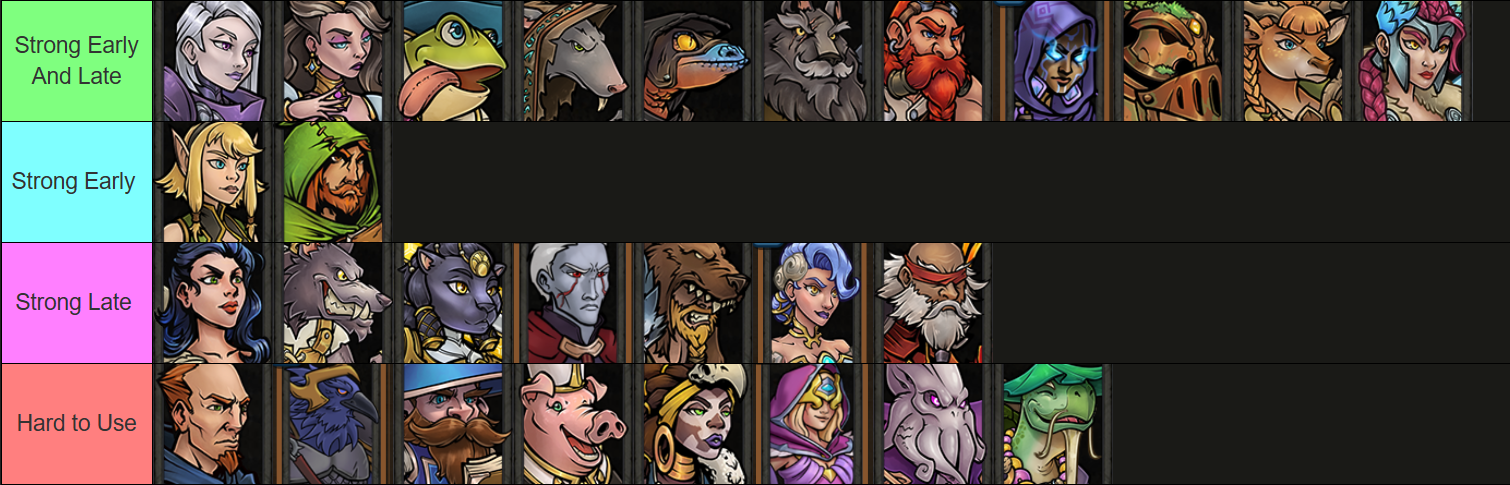
Across the Obelisk teaches new players a useful lie. Warriors belong in the front, Healers belong in the back, and every Hero has a Suggested Role that broadly describes what they are supposed to do. This is excellent onboarding and terrible doctrine. Classes primarily determine card access; they do not prescribe a Hero's job. Warriors can become resource batteries, Scouts can provide the team's defense, Healers can Carry, and Mages can spend an entire combat making somebody else better at violence. Suggested Role should therefore be treated as a starting point for learning a Hero, not a legally binding assignment. At higher Madness, role coverage matters considerably more than class identity. A one-Carry, three-Support composition can still contain a frontliner, a defensive engine, a healer, and a speed controller; those jobs are simply distributed among the three Supports. The question is therefore not whether Heiner is the best blocker or Reginald is the strongest conventional Healer. It is how much of the team’s total workload they perform while doing it. This list therefore measures accessibility rather than viability. Every Hero can clear every difficulty with enough work; some simply require more of it. The list stops at C tier because even its lowest-ranked Heroes can clear with enough love
This list compares Heroes primarily through their level-up rewards, starting decks, and card pools. At Max Madness, Act 1 purchasing restrictions make Divinations one of the main tools for reconstructing weak starting decks. In this list, a useful Divination outcome is not necessarily one particular card; it is any offered card that advances a role the Hero still needs, such as Energy, Draw, Scry, Fast, defence or Carry scaling. Multiclass access affects those outcomes in two opposing ways. A second class can increase the number of different cards that satisfy a required function, but it can also reduce the chance of seeing any one named card. The result is Hero- and build-specific rather than a universal advantage or penalty. It depends on the eligible card pools and rarity distribution, the number of cards shown, what the deck has already acquired, the declining value of duplicate functions, and how shops and the Forge supplement the Divination set. I therefore use Divination-reliant to describe a Hero who needs substantial random Act 1 reconstruction, and Divination-fragile to describe one whose functional floor depends on finding a narrow card or package.
This does come at an economic cost. Low-eco starts or runs can force difficult purchasing decisions that a single-class Hero may avoid by needing fewer shards. Bulk Divinations complicate the issue further; some Heroes rely on finding enough specific cards to reach their functional floor, while a dual-class card pool makes those particular hits less consistent. This makes Gold and Shard perks some of the most important choices to get right in an M18 run.
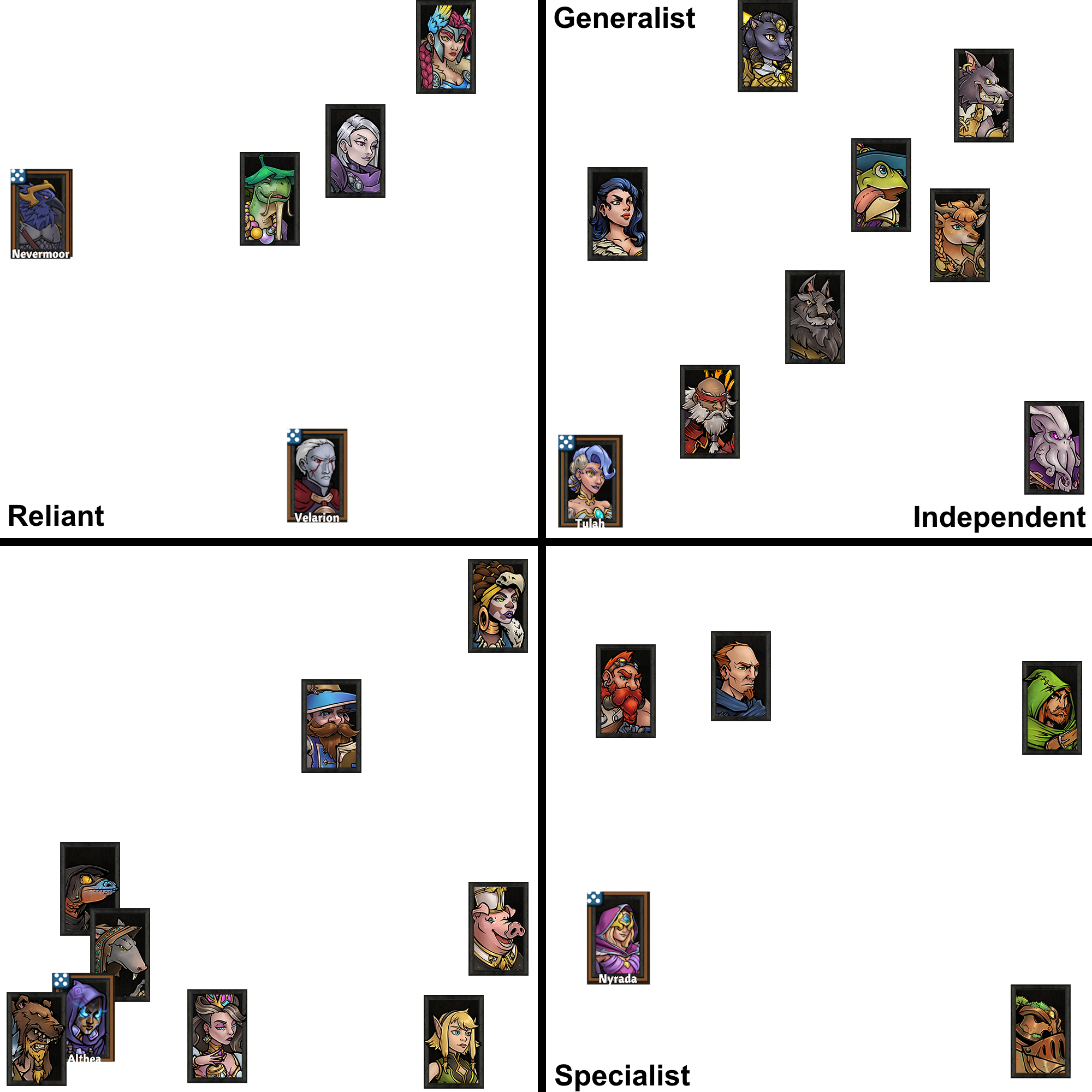
At this level, teams need solutions to many different problems. A Support that performs one job efficiently can devote the rest of its resources to filling secondary roles. The goal when creating a team is not merely to find Heroes that synergise with one another, but to find Heroes that fill the holes left by the rest of the team. A Hero will therefore be judged primarily by how well they perform their intended roles, how easily they can flex into additional roles, and what weaknesses remain while doing so.
-
Magnus is one of the safest single-class Warrior Supports. His starting deck has unusually high card quality and requires relatively little reconstruction, while his high base Speed and easy access to Slow make establishing turn order straightforward from Act 1. His early support package is broad; he can contribute defensive tools, speed control, Carry scaling, and useful cycling without forcing the rest of the team to compensate for a major weakness.His greatest strength is efficiency. Magnus can solve a significant portion of the team's defensive needs through cheap Defense cards while continuing to perform his other jobs. Block beyond what the enemy actually consumes is wasted, so being able to satisfy the defensive floor without devoting an entire deck to it leaves considerably more room for scaling and utility.
His progression does begin to flatten in the late game. Additional Curse application cannot circumvent the limits imposed by Restricted Power, and additional Inspire becomes less valuable once the team already has reliable access to it. His Level 5 options are similarly modest for a dedicated Support. Magnus therefore has less of an explosive endgame payoff than some competitors, but very few Heroes provide useful tools as consistently from the first combat onward. He is rarely the most exciting Support on the team, but he is very often the easiest one to justify.
-
Grukli is probably the cleanest example of a Hero whose class is substantially better at Support than the Hero himself. His starting deck is not completely devoid of useful tools, and the Warrior card pool is strong enough that a functional Grukli Support can certainly be built. The problem is progression. Most of Grukli's unique tools are directed toward Fury, Bleed, Attacks, or improving his own damage, which means very little of his talent tree improves the jobs we actually want a Support to perform.
The result is a character who can carry good Warrior support cards without doing much to improve them. Every Warrior can buy the same core Speed, defensive, and scaling tools, while Magnus, Bree, and Yogger each add something meaningful on top of that shared pool. Grukli usually does not. He is effectively a competent Warrior support deck wearing Grukli as a hat.
This does not make him incapable of clearing as a Support; it makes him difficult to justify against the alternatives. If you want to run Grukli as a Support, the game will permit this decision. It simply offers very few rewards for making it.
-
Heiner’s reputation is deserved if the metric is conventional block output: he produces enormous amounts of it quickly and reliably. The misconception is treating “best blocker” as synonymous with “best Support”. Block only matters to the extent that it prevents damage. A combat ending with 200 unused Block was not made safer than one ending with 20; the additional cards, draws and Energy simply produced a larger unused number. Heiner becomes much more compelling when Fortify converts that defensive specialisation into offensive scaling, because the team is getting paid twice for the same actions.
This does not make Heiner a poor Support. Quite the opposite: his starting Block and Fortify give the team an immediate defensive floor, and he is exceptionally good at making that floor inexpensive to maintain. The important question is what the deck does after enough defence has been generated. Heiner can still draw from the broader Warrior Support pool, but his personal talent tree remains heavily concentrated around defence, giving him fewer unique ways to redirect excess resources than Magnus or Bree.
His other substantial limitation is Speed. Heiner is poorly positioned to establish the team's turn order by himself, forcing another Support to shoulder more of the speed-control package. He is therefore strongest when a team genuinely benefits from his exceptional defensive efficiency or can exploit Fortify offensively. Outside those situations, his greatest strength is also his ceiling: eventually, you simply have enough Block.
-
Bree has a long history of making players reconsider what they thought they were looking for. Her character identity heavily advertises Thorns, and a large portion of community discussion follows suit, so players naturally assume that Thorns must be the primary reason to bring her. This creates an unfortunate chain of logic as difficulty rises: Thorns becomes increasingly awkward to build around, therefore Bree must become increasingly awkward to use. The first half of that assessment can be perfectly reasonable without the second following from it.
Thorns can provide useful incidental value, particularly early in a run, but it does not need to be Bree's main contribution. Her much more reliable Support identity is built around Skills. Bree's high base Speed and starting access to Fast put her in a strong position to act early, while her Skill-focused progression lets her move through a large number of cheap support actions in a single turn. The result is a Warrior well suited to establishing buffs, debuffs, defensive tools, and other setup before the Carry acts.
This is the important mental shift: Bree does not become bad when Thorns becomes bad. She becomes less dependent on the mechanic that initially taught players how to categorise her. Once the starting deck has been cleaned up, she has very few structural weaknesses and can spend her turns filling whichever gaps the rest of the team leaves behind. She isn't the perfect Warrior Support, but she is one of those characters who tends to be understood much better after the player stops insisting on the role they first assigned her.
-
Yogger’s starting deck comes unusually close to a functional Support package for teams using a Sharp Carry, but his Warrior label and starting Intercepts encourage the wrong expectations. Judging him primarily by his ability to Block misses the reason to bring him. Yogger is better understood as a healing and scaling Support with unusually high Speed and access to Warrior cards. Compared with other Heroes performing that role, those are substantial advantages rather than responsibilities he has failed to fulfil.
His Food package combines targeted sustain, draw replacement and Aura scaling. Small healing packets can be directed towards actual deficits, avoiding the waste of producing bulk healing when only one Hero needs attention. Food shuffled into the deck still occupies space before being drawn, but replacing its draw limits the cost of playing it. More importantly, the package retains offensive value after the team is healthy. Yogger can satisfy the healing requirement while continuing to improve the Carry, freeing another Support to concentrate on resources, deck manipulation or defence. This is meaningful role compression because the same package continues doing useful work after one of its jobs is complete.
This gives Yogger an unusual form of role compression. He can provide ordinary Warrior Support while covering enough targeted sustain that another Hero is free to concentrate on scaling, Scry, Inspire, or other utility. The trade-off is that he leaves more of the team’s speed control and conventional defence to somebody else. Yogger does not fit every team, but when the team has a Yogger-shaped hole, very few substitutes actually fit.
-
Andrin produces one of the larger differences in assessment between lower- and higher-Madness players. Much of this comes from Expert Tracker, which performs a role similar to Fortune Telling at zero Energy, on a Scout with excellent access to additional deck manipulation and extremely high base Speed. This makes Andrin exceptionally good when acting first. His starting deck can easily pick up the Fast, Scry, and Draw he needs to make his first turn meaningful, and the deck manipulation to make it all happen consistently.
Wild Hunt gives Andrin a second Support identity beyond turn-order and deck control. For two turns, Energy spent on cards he already wants to play also applies Mark, so the engine does not require a dedicated card and Energy for every charge of Mark. Its marginal cost is genuinely low. However, Mark still needs the correct job description. Restricted Power caps its scaling, but the more important distinction is functional: It is highly effective after the team can already push damage through enemy resistances, but it cannot replace Vulnerable when Slashing resistance is the underlying problem. A Vulnerable-immune encounter therefore remains disproportionately hostile. The relevant comparison is not whether Mark “costs nothing,” but whether Andrin’s complete package of Speed, Fast, Trace, deck control, and Mark outperforms the alternative Support package choices.
His starting deck does require meaningful reconstruction, so his excellent Act 1 should not be confused with a prebuilt Support deck. What he does have is an unusually strong foundation to rebuild around. The larger limitation is progression: much of what makes Support Andrin exceptional is already online relatively early, and his personal contributions improve considerably less after roughly Act 3. He starts near the roof and then becomes quite comfortable living there.
-
Our frog of wonder remains extremely difficult to argue against. His starting deck already contains several relevant Support tools, and his good base Speed combines nicely with the generally excellent Scout card pool. He can contribute speed control, scaling, sustain, and deck support without requiring the team to bend particularly far around him.
His more distinctive value arrives through Songs and, eventually, Shrill Tone. Shrill Tone allows Sharp to scale Mind damage, opening a route that Mind Carries normally cannot access. The problem is placement. Until Level 3, Sharp does nothing for Mind damage, meaning a team that intends to use the interaction either has to delay building around it or perform a fairly substantial deck pivot once it comes online. This makes Shrill Tone much less accessible than its eventual ceiling would suggest.
Gustav's weakness is therefore less that he has a poor early game and more that some of the strongest reasons to choose Gustav specifically do not exist until relatively late. Before then, he is primarily just a Scout carrying Scout cards, which is hardly a tragedy, but a team struggling through the earlier Acts may not receive the immediate payoff it was hoping for.
-
Nenukil performs considerably better as a Support once you stop feeling obligated to use the mechanic printed in enormous letters across his character. Loaded Gun contributes very little to a conventional Support plan, and building around Reload simply because Nenukil happens to have it creates a large amount of machinery without necessarily solving any of the team's actual problems.
What remains is mostly a Scout card pool with a few convenient early defensive tools. Caltrops gives him cheap access to Block and Thorns, which can make him a surprisingly comfortable frontliner in the first Act, but this should not be mistaken for a meaningful defensive talent package. Much of Nenukil's progression either improves damage directly or rewards Support cards by making them deal damage, which contributes very little in a composition where somebody else has already been hired to kill things.
His base Speed is also mediocre for a Scout, and his traits contribute almost nothing to the Support gameplan. The result is a Hero who can absolutely carry a competent Scout Support deck, but receives remarkably little help from Nenukil himself. Sometimes the correct way to play the Engineer is to leave most of the machinery in the closet and let him explore other interests.
-
Sylvie contributes relatively little to a general Support role beyond access to the Scout card pool, but describing her as completely blank misses one important exception. Keen Sight and Target Shooting give her unusually direct access to Piercing resistance reduction. In a Carry composition that actually cares about Piercing damage, this is real and potentially substantial value.
The problem is specificity. Her starting deck requires extensive reconstruction, her base Speed is mediocre for a Scout, and most of her talents continue trying to convince Sylvie that she should be the one shooting things. Outside a Piercing composition, very little of her personal kit helps solve the jobs we require from a Support.
The traditional Yogger robbery line also exists: Sylvie gets herself thoroughly stacked and Yogger redistributes the goods. It works, although involving two consenting adults in an elaborate transfer scheme remains a surprisingly complicated way to apply Sharp.
Sylvie is therefore less a bad Support than an extremely narrow one. If the team specifically wants her Piercing resistance package, she has a reason to exist. Otherwise, another Scout will usually provide the same class tools with considerably more attached.
-
Thuls suffers from much the same problem as several low-ranking Supports: the Scout card pool is doing almost all of the work. His starting deck and personal traits are overwhelmingly interested in Attacks, Poison, Stealth, and his own damage, leaving relatively little that directly improves the jobs we actually want him performing.
Poison does create several niche Support routes. It can contribute to Shadow resistance reduction, or be routed through more elaborate Dilute/Baptism pipelines into useful resources. These lines function, but they require enough additional infrastructure that they rarely justify choosing Thuls.
Hidden Hand is the notable exception. Turning an empty hand into five additional cards and 3 Energy is a genuine Support payoff, but it arrives late and asks the deck to be constructed and sequenced around it. By the time it comes online, many strong teams have already solved the resource problems it addresses. Killer Instinct also earns an honourable mention for being, in this context, a worse Adrenaline.
Thuls can absolutely carry a competent Scout Support deck. The harder question is what Thuls himself contributes to it, and the answer usually arrives too late and asks too much.
-
Amelia’s strongest Support lines are much more convincing when she is allowed to dictate the sequence rather than react to it. Her natural Chill access can contribute to additional speed control after Scroll of Speed, while Spellsword and Ice Palace provide a respectable defensive package. The problem is that Spellsword still has to be generated. Spending Energy on cards primarily to create defensive value is much less impressive than simply playing the Support cards the team already wanted.
Time Loop is her most interesting Support tool. Recycling vanished cards can return premium tools such as Scroll of Intellect, Ice Barrier, Blood Alchemy, or strong corrupted cards at heavily reduced costs. This is not automatically an upside. Time Loop shuffles those cards back into the deck, meaning an undisciplined Vanish pile can immediately vandalise an otherwise deterministic Scry setup. A carefully constructed Amelia can make this exceptionally strong; a careless one gets to discover why “more cards” and “better deck” are not synonyms.
This leaves Amelia in an awkward but legitimate niche. She can provide unusually large amounts of defence for a Mage while recycling some of the class's strongest Support cards, but both engines ask for considerably more setup than the premium Mage Supports. If you specifically need a Mage to behave like a Block tank, Amelia is probably the first place to look.
-
Our old Dementia-maxxer earns an absurd amount of his Support placement before the first card is purchased. Starting with two Scrolls of Intellect gives him immediate access to two of the strongest Mage Support cards in the game. This dramatically lowers his Act 1 reconstruction cost and gives him a consistency advantage that most Mages have to purchase.
Having secured most of his placement before the first shop, Cornelius then proceeds to spend much of his talent tree becoming a Fire Mage. Most of his talent progression remains focused on Fire damage, leaving the Mage card pool to perform much of the actual Support work. He can continue adding Scrolls, Blood Alchemy, Mana Gem, and the usual Mage utility to become a comprehensive resource battery, but his personal progression does relatively little to raise that ceiling. In Fire or Frostfire compositions, Burn application gives him an additional route into resistance reduction, which helps prevent him from becoming entirely generic.
Cornelius is therefore almost the inverse of Wilbur: much of his value comes from arriving with the right cards rather than eventually receiving the right talents. Conveniently, Act 1 is precisely when that distinction matters most.
-
Velarion, like most multiclass Heroes, is difficult to analyse. Combining the Mage and Healer card pools gives him access to Fast, Inspire, Energize, Bless, universal resistance reduction that does not collide with Vulnerable, and enormous amounts of healing. This makes him appear universally desirable. At higher Madness, however, Healer decks seldom remain dedicated healing decks. Once sustain has been solved, the pool is primarily valued for its buffs, dispels, resources and deck control. Velarion therefore looks strongest when Leech handles healing passively and frees both of his card pools to perform other jobs. Even then, access to tools is not compression of tools, and Velarion repeatedly stumbles over the cost of combining them.
The common low-Madness build rests Velarion’s healing on Lychee, upgraded Curse of Blood and his starting item. At higher Madness, that package begins to collapse under its own construction cost. Curse of Blood consumes four deck slots and a substantial portion of his Energy, while his starting item applies only small amounts of AoE Leech. Together, these pieces can brute-force an early Leech explosion without requiring additional cards, but accomplish little that Arcane Drain cannot achieve more efficiently. Lychee is not evidence that Curse of Blood is good. It is a 1,200-Gold subsidy paid to help four mediocre cards reach a threshold that two Arcane Drains approach with half the deck space and Energy cost. That Gold must then be taken away from Divinations or more generally useful items such as Draw weapons.
The resulting Leech explosion presents another problem. It does not provide 100 freely distributed healing, but four separate packets of 25 that cannot migrate towards the Heroes who actually need them. When damage is concentrated onto one Hero, three-quarters of the advertised healing disappears into full health bars. This problem only becomes worse once the team reaches healing saturation and further explosions accomplish nothing. The package is not efficient; it is merely large enough to conceal its inability to target anyone. In this way, the popular Curse of Blood/Lychee package functions as training wheels for players judging healing by the size of the combat-stat number rather than where that healing went or what it cost to produce.
Leech’s resistance reduction is similarly self-defeating. Bulk AoE application is difficult to achieve, leaving the mechanic mostly as targeted resistance reduction. Allowing Leech to explode then removes the charges producing that reduction, forcing the player to choose between preserving its offensive value and triggering its healing. As resistance reduction, Leech is therefore best treated as a supplement to Vulnerable. Its healing can still be enormous, but remains poorly targeted and vulnerable to saturation.
Arcane Drain performs the Leech job much more efficiently and opens several additional lines while Healer access to Scry and Expected Prophecy makes finding both copies considerably easier. Arcane Drain is often used to place large amounts of Bleed onto an ally, enabling Burning Blood to generate substantial Fury as early as the first combat. This is powerful, but another Hero must still draw and cast Burning Blood, sometimes forcing the Carry to spend part of their own turn completing Velarion’s setup. The interaction creates access to Fury; it does not compress the resources required to produce it.
Most of Velarion’s talents fail to bring these pieces together. Life Surge’s 4 Vitality is useful but slow, while Voracious usually expands a healing package already approaching saturation. Bleeding Blight is effectively dead outside extremely niche lines because its two-charge-per-turn limit prevents it from scaling with meaningful Burn or Dark application. Crimson Ripple has a real ceiling in dedicated Fire compositions, but Burn is already too accessible to justify constructing an indirect route towards it, especially when doing so costs Velarion his Energy talent. Forbidden Feast has little purpose under the Carry-Support framework, while his Level 5 talents can provide any remaining Inspire or Energize only after most of the run has already been completed.
Bloodbargain is the major exception. Divine Power and Arcane Drain are already desirable cards, meaning Velarion can prepare its Overcharge requirement without purchasing speculative pieces or rebuilding his deck when the talent arrives. With Overcharge established, Bloodbargain allows him to trade away his life for 10 Energy, exceeding the normal Energy ceiling entirely. Much of the resulting turn can be spent restoring Velarion, but that healing can also repair the rest of the team while leaving additional Energy for other Support work. Bloodbargain therefore represents one of the game’s largest power swings because it joins cards Velarion already wanted rather than asking him to construct another separate engine.
Velarion’s power curve ultimately fails to align cleanly with the game’s own. His card pools and raw healing give him a powerful floor, but much of his talent progression either expands an already-solved role or redirects him into another expensive package. Velarion is unquestionably powerful, but the same Leech shell fitting into many compositions demonstrates compatibility rather than versatility. His individual tools are strong; combining them efficiently can warp an entire composition around problems that simpler Support structures never created.
-
To do: This
-
Evelyn offers much stiffer competition to Cornelius than her starting deck initially suggests. Two Transmissions and a Mana Gem give her a legitimate Support foundation immediately, but much of the remaining deck still needs replacing. She therefore pays a similar Act 1 reconstruction cost to Cornelius.
However, Evelyn rarely suffers from being presented with more than one attractive option. Elemental Weapons and Elemental Proliferation are prime candidates for applying bulk Keywords. Although Elemental Weapons is particularly good at helping another Hero experiment with a different type for a while, 12-charge limit prevents Elemental Weapons from being fully consistent. Spell Echo is the larger payoff. Giving another Hero a zero-cost copy of their next Spell is exactly the kind of interaction we value in a dedicated Support: Evelyn supplies the mechanism while the Carry supplies the card worth duplicating. The effect remains useful across an enormous number of compositions and gives Evelyn a much stronger character-specific late game than most single-class Mages.
Combined with her easy access to Fast, these talents let Evelyn add Hero-specific utility to the already excellent Mage Support pool rather than merely improving her own Spellcasting. That distinction carries her a long way.
-
Zek has a few useful Support pieces, but remarkably little reason to occupy the role himself. Three copies of Curse of Exhaustion give his starting deck legitimate speed-control tools, and his slightly higher Speed for a Mage helps him enter the team's initiative chain more comfortably. Dark Ritual is the card you start looking at when the spreadsheet says: ‘We need more Energy and the cupboard is becoming concerningly empty,’ but pales in comparison to the normal Mage Support tools. It costs Energy and health to provide Energize without Inspire and tends to only appear when a team is scrambling to find extra Energy.
Dark Feast has some fascinating interactions with the Support role, because it states any card instead of “Spell” allowing it hit some of the premium support cards like Tome of Intellect and Transmission extremely favourably. Putrefaction provides a legitimate route into Shadow resistance reduction, but introduces an awkward problem of its own. Zek is already one of the strongest vehicles for Shadow damage, so using him to Support a Shadow Carry often means removing one of the best candidates for the Carry position in the first place.
Zek can carry the excellent Mage Support pool perfectly well, but most of what makes Zek specifically desirable would rather be killing things. If you're desperate for another Mage Support, he functions, particularly in a Shadow composition, but Evelyn or Cornelius will usually perform the job better, because asking Zek to support another Shadow Carry has the peculiar feeling of asking the most judgemental person in the room to supervise someone else doing his job.
-
Wilbur finds himself in a contradictory position of being simultaneously a noob trap and a powerhouse. Getting him off the ground floor takes significantly more work than our Big 4 Mages. His starting deck contains none of the cards that define his eventual battery, so reaching that role in Act 1 generally requires substantially more random acquisitions than it does for Evelyn or Cornelius.
His starting talent targets randomly,reducing his consistency. He cannot begin with a functional support deck without heavy reliance on Divinations, while Twin Scrolls doesn't become particularly impressive until the late game. Skillful at Level 2 is the usual pickup, but it has its own basket of snakes. With limited scrying tools, it often falls prey to the Exhaust mechanic if it's not in the top two-thirds of a deck. With excess Scry, Skillful can be guaranteed and the deck shuffled so that Exhaust becomes largely irrelevant. The problem is that scrying tools are a heavily contested resource and are often consuming the consistency that other Heroes would like. Scholar comes next, but falls slightly short of Duality, leaving it somewhat below the usual benchmark. Transcribe is where his curve finally begins to improve, and usually this is where Twin Scrolls comes online. Placing two zero-cost Spells into a Hero’s deck can be exceptional for Energy economy. Wilbur usually seeks out Dimensional Crystal at this point, which is one of the most reliable non-boss item pickups. Unfortunately, his power curve flattens again at level 5. Energizer feels excellent for a team that is regularly starved for Energy. However, by Level 5, a team that has already carried an Energy-hungry deck through Acts 1-3 must possess enough economy to function before Energizer; the trait can at best improve an existing engine rather than creating one.
The conventional case for Wilbur is entirely real. A completed battery can make every other Hero feel as though the normal Energy rules have been politely suspended. The ranking disagreement is about when that engine exists and what is required to assemble it. Cornelius arrives with two Scrolls of Int; Evelyn arrives with two Transmissions and a Mana Gem. Wilbur begins with none of his eventual battery package, consumes contested Scry to stabilise Skillful, and Twin Scrolls does not come online till the run is well underway. He is not weak. He is backloaded and Divinitation-fragile in a tier list that places a heavy weight on Act 1 consistency.
-
Malukah initially looks like somebody spilled half the Healer keyword list across a character sheet and decided to see what happened. Her starting deck does little to disprove this, with Malediction being the obvious standout and much of the remaining deck requiring substantial reconstruction. The important shift is realising that several of those apparently unrelated mechanics are actually conversion tools.
Her Level 2 talents are a good example. Yin Ritual converts Dark application into team-wide Regeneration, while Yang Ritual converts Regeneration application back into Dark. Because Malukah's innate Voodoo turns Dark application into healing, ordinary Regeneration cards can suddenly produce considerable healing, while Dark utility can quietly supply sustain on the side. With the right Spells and items, these loops can become surprisingly efficient, allowing Malukah to cover much of the team's healing without devoting much of her turn to explicitly healing anyone. Her talent progression repeatedly threatens to cohere before wandering off again. Levels 2 and 3 can build surprisingly efficient healing and Dark conversion lines. Level 4 is where Malukah's progression drives directly into a retaining wall. Vaccine is particularly difficult to justify: rather than providing its effect immediately, it adds a 1-Energy Enchantment to Malukah's deck. This costs both a draw and Energy before providing any value, and its uses do not begin until a later turn. In a format where developed teams are increasingly ending combats within one or two rounds, Vaccine is a long-term investment offered shortly after the concept of “long term” has begun to disappear.
Twilight Swamp is where Malukah's Support package becomes considerably stranger. Depending on the upgrade, the card can be Global rather than merely targeting all monsters, meaning its Dark, Wet, Slow, and Courage interactions must be considered on both sides of the field. The enemy-side package alone gives Malukah speed control, resistance manipulation, and buff removal in a single draw. Twilight Swamp therefore does not function as a conventional Healing Spell so much as a way to load several different mechanisms at once.
Her problems are therefore less about lacking Support tools and more about accessibility and consistency. The starting deck still needs significant work, several of her talents remain more interested in damage than Support, and her best conversion engines become much more impressive when particular cards or items cooperate. When those pieces do cooperate, however, Malukah can compress an alarming number of jobs into very few actions.
She still struggles to compete with the cleanest high-end Healer Supports, especially when another Hero can provide the same Carry scaling with less assembly. But writing her off as an incoherent Dark Healer misses the strange little economy underneath. Malukah does not always know what currency she is being paid in, but she is unusually good at laundering it into health.
-
Nezglekt comes wrapped in an alarming amount of Insane and Sight nonsense, only to reveal one of the strongest starting Support decks in the game underneath. Someone appears to have accidentally left two copies of Expected Prophecy, two copies of Scry, and Banish in his starting deck. This gives him excellent deck control before the first shop. Adding the usual Healer access to Inspire and Bless allows Nez to assemble a comprehensive Support package extremely early. Night Terror also deserves an honourable mention as reliable resistance reduction against Bosses and Champions, with particularly high value in physical compositions.
Fated Future is the major talent payoff. Its enormous cost reduction represents roughly seven additional Energy when fully exploited, and, critically, that value can be placed on the Hero whose turn actually matters. Mental Leech can contribute enough incidental healing that Nez seldom needs to devote much of his deck to sustain, but building the entire composition around Insane reverses the relationship. The healing is a useful by-product; the deck manipulation and resource funnelling are the reasons he is here.
His eventual ceiling is slightly less extravagant than the multiclass supports like Bernard and Laia, but very few Heroes reach their functional floor as quickly or cheaply. Nezglekt does not need much help becoming useful, which is rather convenient because he is generally occupied predicting the future.
-
Ottis runs into the same trap as several heavily defensive Heroes: the game makes it extremely easy to keep solving a problem that has already been solved. His starting deck contains a substantial amount of Shield, Block, and Courage, while Shielder converts part of that Shield into healing. This makes his early defensive floor considerably better than it first appears, particularly with Orby.
The problem arrives when the team is already safe. Double Bubble can duplicate a very large Defense card at zero Energy, and his later talents continue improving Shield and Holy Spell efficiency, but additional defence has sharply diminishing value once enemies are no longer threatening the team. Ottis can become exceptionally efficient at producing a resource the composition no longer needs.
Sanctify gives him another route into carry support, particularly in Holy compositions, but his personal access is generally less impressive than dedicated Sanctify packages from Reginald or Tulah and less specialised than Laia. Then Paladin Gauntlets happens.
Paladin Gauntlets allows Courage application to generate Bless, turning much of Ottis's existing defensive machinery into offensive scaling. The deck suddenly becomes extremely simple: a small package of efficient Defense cards, resource generation, Scry, draw, and enough Courage application to turn the pig into a Bless factory. Getting to that point can be awkward, but the transformation is significant enough that it deserves to define his strongest practical build.
Ottis suffers from much the same problem as Heiner: he is exceptionally good at solving a problem with a finite answer. Heiner eventually has enough Block; Ottis eventually has everyone alive. After that point, additional defensive output needs somewhere else to go. Ottis is therefore not a universally premium Healer. Without a way to convert his excessive defence into another useful role, his ceiling arrives surprisingly early. With Paladin Gauntlets, the ceiling appears to have been improperly installed.
-
Reginald's central problem is not access to Bless, but ownership of it. His innate steadily applies Bless to himself, which looks excellent until we remember that Support Reginald is not the Hero being paid to deal damage. The additional healing received is useful, but most of the offensive value is sitting on the wrong side of the table.
Divine Grace is the clear exception and an excellent Act 1 card, providing targeted Bless alongside healing and draw. Healing Surge offers another route by refunding Energy from Healing Spells and applying Bless to the most damaged Hero, but this is automatic rather than directly targeted. The Carry receives the scaling only when their health happens to cooperate with the plan.
The stranger problem is that Reginald eventually becomes too efficient at healing for Healing Surge's trigger condition. Focus Heal can provide most or even all of the sustain a developed team requires, leaving little incentive to repeatedly cast paid Healing Spells simply to manufacture Bless. Divine Power also reduces the relative importance of Divine Grace as the run develops.
Reginald therefore has no difficulty keeping a team alive. Keeping a team alive is simply not the difficult part of being a premium Healer Support. He performs the basic role comfortably, but his most heavily advertised scaling mechanic remains frustratingly reluctant to leave home.
-
Tulah quietly begins with one of the cleaner Healer Support decks with access to Courage, Inspire, Dispel, and deck control before the first shop, while many of her less important cards conveniently Vanish after use. This substantially reduces the reconstruction demanded by most Healers in Act 1.
Broodmother is more complicated than it first appears. Spiderlings cost zero Energy, replace their own draw, and Vanish, making them remarkably unobtrusive once played. The tradeoff is deck pollution: a Spider may replace its draw when played, but it still occupies a position in the deck before then, which consumes Scry bandwidth until drawn. The Spiders are cheap once drawn, but expensive while unfound. Spiderlings are draw-neutral after you find them, not deck-neutral before you find them. When Spiderlings apply Sanctify, they let Heroes convert Attacks they already intended to play into incidental sustain without adding healing cards to their decks.
Webweaver is an exceptionally strong effect arriving at an awkwardly late stage of the run. Global Shackle that continues functioning against Bosses would be premium speed control earlier, but by Level 5 most developed teams have already solved initiative. It therefore raises Tulah’s ceiling more than it improves her accessibility.
Tulah still requires more care than the cleanest generalists, and her Spiders can become actively irritating in highly deterministic Scry compositions. But describing her as merely “slightly above average at everything” undersells both her excellent starting floor and her ability to distribute low-action-cost sustain. She does not immediately look like one of the premium Healers. This appears to be Tulah's preferred arrangement.
-
Laia is a premium Support for a large number of compositions, although she has a habit of convincing players to build far more Laia than the team actually requires. Her starting deck is imperfect but contains several unusually valuable pieces. Lay on Paws is excellent targeted Bless and almost never needs to leave, while both copies of Inner Fire can cheaply upgrade into zero-Energy targeted Powerful. Intercept, Prayer of Protection and Holy Nova can provide enough defence and Sanctify application to be useful through Act 1, even if the four Holy Slashes leave plenty of cleanup to do.
Laia’s real advantage is being a Healer with access to Warrior cards. Both pools contain multiple acceptable outcomes for defence, Energy, Carry scaling, and deck control. She therefore does not need every Divination to find the same named card: several different cards can advance the same missing role. That breadth does not make every Divination good, and it does not establish a universal probability advantage over single-class Heroes. It makes Laia less dependent on one narrow package. Therefore, Laia is Divination-reliant but not Divination-sensitive. The remaining cost is economic, because a broad set of acceptable offers only helps when the party has enough shards to act on them.
Her talent tree continues this flexibility rather than giving her one mandatory engine. Purrification can turn Defense cards she already wants to play into resources. Duality provides an extra clean 3 Energy per turn, and Heavenly Protection lets a Defense card provide Shield, Bless and Zeal to the entire team.
Laia’s strongest internal synergies are not entirely self-contained. Zeal improves Sanctify healing, which in turn improves Overflow, but Laia naturally supplies surprisingly little of either resource herself. This becomes much less of a problem when the rest of the team can provide them incidentally; Tulah, for example, can supply Sanctify while performing her own Support role, while Basthet’s Grace from the Pyramid can reliably solve much of Laia’s Zeal access. Apparently, centuries of questionable age-gap yuri have at least taught her the value of sharing resources. The danger is overcommitting to these interactions. Laia is strongest when she takes whatever jobs the team is missing, not when every Keyword on her character sheet is forced into the same relationship.
-
Navalea is one of the strangest Supports to evaluate, with an awful starting deck attached to two of the best Support card pools in the game. Mage and Warrior give her so many useful targets for Energy, draw, speed control, defence and debuffing that she is Divination-reliant, but not Divination-fragile. She requires substantial Act 1 reconstruction, but her multiclass pool makes acceptable outcomes relatively common. Curse of Torment is the major piece of her starting deck that does not need replacing, and becomes increasingly important as the run progresses if going the Scourge route.
Level 3 is where Navalea explodes into relevance, with two genuinely excellent choices. Duality supplies 3 Energy per turn and lets her begin above the normal 10-Energy cap. Aura of Despair, however, is a bit trickier. Vulnerable normally remains a contested and limited Support resource, but starts looking pale compared to Scourge, and when combined, Navalea becomes a one-woman Resistance Remover. Curse of Torment works effectively before level 4 to prioritise specific targets, but at Level 4 the targeted resistance becomes AoE resistance removal, and most combats collapse from there.
Defensively, Navalea has no exceptional personal engine, but Mage and Warrior together provide broad access to Block, Shield, Reinforce, Insulate, Infuse and speed control. More importantly, Navalea's role compression lets the other Supports become more defensive, since a team no longer spending heavily on Vulnerable, Inspire and Energize can put those resources somewhere else. Navalea ultimately begins as an expensive but unusually forgiving generic Support and ends as a resistance-reduction engine powerful enough to stop caring what damage type the Carry uses.
-
The worst part about running Sigrun as a Carry is that you do not get Sigrun as a Support. Her high base Speed and access to both Scout and Mage cards give her almost everything required of a first-acting Hero. Scout supplies turn-order control, draw, Scry, and some deck manipulation, while Mage supplies some of the game’s strongest Energy tools. Acting first lets Sigrun establish Fast and Slow, construct later hands, and distribute resources before the other Heroes take their turns. This starts the team’s snowball before anyone else has acted.
Sigrun does not begin with a deck capable of realising that potential. Most of her starting cards are damage-facing and need to be removed, creating one of the larger Act 1 reconstruction costs among the strongest Supports. This makes her intensely Shard-hungry, but not necessarily Divination-fragile. Scout and Mage contain numerous acceptable outcomes across most Support functions, so Sigrun is more dependent on acquiring a large number of functional cards than on finding one exact package. Her combined card pools make that reconstruction forgiving in what it can accept, but expensive in how much it must replace.
Sigrun needs to spend heavily replacing her starting deck, making cards like Bookworm simultaneously one of the cards she wants most, and one of the luxuries she can least justify purchasing. Finding Bookworm dramatically improves the runs in which it appears, but an expensive card that is not consistently available cannot be priced into her baseline. It represents Sigrun’s ideal Act 1 engine, but not the consistency she can expect every run. She cannot reproduce the consistency Expert Tracker gives Andrin, so Andrin retains the more preconstructed opening despite sharing the Scout pool. The tradeoff is clear: Andrin begins closer to his ceiling, but Sigrun gets Mage cards.
Duality is the centrepiece of that package. After purchasing Adrenaline in Act 2, Duality raises her effective Energy to 9. Because she acts first, those 3 points of effective Energy enter the snowball before it has begun compounding. Duality is not mechanically stronger on Sigrun than another Hero, but Sigrun’s position lets its value propagate further downstream. Extra Energy on a Carry is generally converted into more damage; on Sigrun, it can become resources for the entire team.
Rain is usually among the last cards removed from Sigrun’s starting deck. Its 0-Energy cost makes it an efficient early trigger for Magic Rune and draw books, with the occasional synergy with Cold and Lightning compositions and occasional Baptism lines. This makes rain an excellent transitional card, but it often cannot survive scrutiny past Act 3. Even when Wet is relevant, it does not compare with Bless as a foundational scaling. Once a draw engine has been established, and a comprehensive deck has been constructed, rain becomes as functionally empty as Yogger generating healing into a team at full HP.
Sigrun’s remaining talent progression is considerably less impressive than her class access. Levels 1, 2 and 4 contain conditional utility, but do relatively little to solve the expensive process of constructing her Support deck. Magic Rune can provide valuable cycling, but is a payoff for having already assembled a suitable Spell package rather than a tool that builds the package itself. Valhalla is the exception in power and the same problem in timing: too late to justify choosing Sigrun, yet far too strong to ignore. It contributes nothing to the unstable part of her run, since the team must already survive the early Acts and assemble its engine before the talent exists. Its timing is much more favourable for compositions that comfortably clear ordinary encounters but lack the sustained or concentrated damage required by the final boss. Valhalla acts as insurance against the final boss, without necessarily assisting in reaching it, making it only a minor contributor to her placement.
Sigrun is ultimately an expensive Act 1 project attached to one of the strongest possible Support foundations. Her starting deck and sparse early talents make assembling that foundation considerably harder than her class combination suggests, but the tools she has access to reward that investment with an exceptional engine.
-
Bernard is the most misunderstood Hero in the game, largely because the game presents him backwards. Poison, Rust, Wet, Thorns and other Keywords scattered across his kit have little internal synergy, while Flasks are difficult to access, narrow in scope, and generally below the power level of our more commonly used cards. His talents make this worse by pointing towards a dedicated Flask deck, despite only providing a limited number of useful triggers. Healing Flasks can be nice trickle sustain but this is not permission to ram his deck full of Flasks. The public assessment that Flask Bernard is bad is largely correct. The mistake is assuming that this is the only way to play Bernard.
Bernard is better understood as a Healer with access to Scout cards. His starting deck is still mostly horrid, with Uproot providing the major exception through immediate Vulnerable access. Replacing the rest makes him extremely Shard-hungry, but Scout and Healer offer enough acceptable outcomes that his functional floor remains easy to find. He is Divination-reliant but not Divination-fragile: the problem is paying for enough replacements, not finding one exact package.
His base Speed is genuinely awful, but it only prevents him from leading the Speed chain, rather than operating inside it. A conventional First-Hero can place all three Supports in front of the Carry, after which Bernard can apply Fast and complete the ordering. He cannot be the first Hero, but he can still fix the order.
Scout gives him Energy, draw, Scry, deck manipulation, Fast, Evasion, and Vulnerable, meanwhile Healer gives those tools much stronger things to find. Divine Power provides scaling, while Clarity, Fortune Telling and Scry provide the deck consistency. Delay Tactics gets particularly interesting when the hero can also apply Fast.
Scavenge is where this becomes criminal. Scavenge can retrieve any non-Vanished card from the Discard pile and becomes a second copy of whatever matters most. Scout usually limits this with its mediocre individual card quality, but Bernard gets to use the same recursion on Healer cards that are individually far more powerful. Scavenge can therefore reproduce standalone powerful cards in ways that ordinary Scout decks struggle to capitalise on.
Duality provides a reliable 3 effective Energy per turn, and comes an at opportune time in the run. Alkahest arrives too late to explain Bernard’s accessibility, but gives compositions that struggle against bosses an exceptional closing route.
Bernard succeeds despite the mechanics presented as his identity, not because they secretly form a good Flask deck. His starting deck is expensive to repair, and his Speed restricts his position, but Scout economy and manipulation gain access to Healer-quality scaling. The disparity between the Hero players are encouraged to build and the Hero hiding underneath is why his ranking on this list will surprise so many people.
-
Nevermoor is difficult to analyse because his character sheet presents flexibility as though it were already role compression. His access to both Warrior and Healer cards gives him a broad Support pool containing defence, healing, buffs, Speed control, and resource generation. His respectable base Speed, Push Forwards, and access to Piercing Howl provide immediate turn-order utility, while Rune Catalyst begins establishing his personal engine. Beyond these initial tools, his starting deck requires substantial reconstruction, making him considerably more expensive to operate than most other Heroes.
Much of that construction cost comes from Runeweaver itself. It would be misleading to treat the Energy from Runeweaver as a direct cost of the Rune, since the underlying card still performs its normal function, so the real cost of Runeweaver is the pressure it places on deck construction. Many excellent Support cards are valuable specifically because they cost very little, while Nevermoor is encouraged to purchase more expensive cards, maintain the correct balance of card types, and play them in an order that establishes his Runes quickly. This makes him intensely dependent on Draw, Energy and access to Scry, with the cost of supplying those resources forming the central problem in his evaluation.
The Runes offer a powerful return on that investment, but do not combine as cleanly as we might want. Blue and Green Runes, once established, produce massive amounts of defence and healing, and Fortify even scales damage in some compositions, but both encounter hard saturation points. Their value collapses once the team is adequately protected or already at full health. Blue can even undermine Green by preventing the damage required to produce meaningful healing. Red Runes theoretically provide an outlet after healing and defence have saturated, but their Mark application presents another construction problem. Expensive multi-hit cards such as Whirlwind can apply Mark in bulk but are difficult to fund, while cheaper damage cards like Cleave apply too little Mark to justify them. Meanwhile, cheap cards that are good at applying Mark like Dawnlight, do not apply Red Runes. This makes his Mark application shaky even under optimal conditions.
Flexibility is not role compression. Nevermoor can be constructed to heal, defend, or contribute damage, but selecting between the several roles is different from performing all of them efficiently within one deck. Genuine role compression requires the same cards and resources to solve several problems simultaneously. Nevermoor can instead end up purchasing a separate engine for each role. Enough Draw and Energy may allow him to operate all of them, but supplying more resources does not make those roles compressed.
Nevermoor therefore excels not by compressing several jobs into one efficient package, but by turning broad card access and abundant resources into an extremely strong toolbox. In a team that is able to fund his early setup, construct his hands correctly, and remain in combat for long periods of time, he can answer an unusually wide range of problems. This tier list places him lower because it prioritises Act 1 construction cost and the ability to create role compression efficiently with limited resources. Teams built to move fast and hit early have little use for Nevermoor.
-
Nyrada’s critics often arrive at a reasonable placement through the wrong arguments. Dismissing her as an underwhelming Dark specialist ignores how much a normal Mage-Healer deck already accomplishes. Bless, Powerful, Energize, Draw, and Scrying tools give her a good place in any composition, and Scroll of Speed lets her participate in the initiative chain comfortably. She does not need a personal engine to function. The question therefore becomes how much of her kit improves a Support deck that other Heroes can also construct.
Dark Mercy makes that distinction particularly important. Healing attached to damage looks like role compression, but the resources spent producing that damage still matter. Dark explosions cannot use the damage scaling already desired by conventional Carries, while Resistance reduction eventually caps and efficient Scourge access is scarce. Building around those restrictions to obtain healing often costs more than simply purchasing healing, especially when losing Rhythm of Magic becomes part of the cost.
Its healing also arrives behind an additional threshold. Until Dark explodes, the talent provides no sustain; when it does, the entire packet goes to one Hero and any excess is wasted. Compared with Malukah’s ability to distribute small packets of healing as needed, Nyrada’s thresholded healing falls short. Explosions triggered by other Heroes weaken this comparison but do not resolve the cost of producing the explosions.
Shadowbound offers a much more convincing reason to consider her. Shadowbound allows for large bulk Dark application on a single target and when combined with the Resistance loss, Shadowbound offers significant role compression and damage density, even at 2 Energy.
However, she falls on her face again because most of her talents provide useful advantages without resolving the cost problem. Rhythm of Magic misses some of the game’s best Skills. Cursed Mirror earns points for Scourge access, but its application method proves unreliable, while Purifying Resonance injects Block and Shield into a role that often has no use for them. Nightmare Storm produces significant Dark by consuming every other Curse, hardly proving itself a good use of three Energy and a card. Both Level 5 talents arrive when the game is mostly solved and attempt to repair problems the team has already addressed.
Dream Harmony has a stronger case because existing Sanctify or Regeneration can supply its triggers without additional healing cards. Its resources can also contribute immediately when delivered before the recipient’s turn; Inspire is not automatically a next-round benefit. The problem is its Level 4 arrival, when the team already needs a functioning resource plan.
Revealed Dreams is similarly difficult to value as a dependable contribution. Its manual application combines a spending threshold with random targeting, and an inconvenient surviving target prevents another attempt. Sacrificing useful discounts to force activation can make the supposed bonus expensive. Summoned enemies are the meaningful exception: automatic Expose can provide substantial value without those construction problems. That gives her particular encounters in which she excels, rather than a consistent advantage across the run.
Nyrada is therefore broadly usable, and claims otherwise underestimate her card pools. However, her lower placement stands and reflects how conditional or late her personal advantages remain. She can support a strong team without difficulty; giving that team a compelling reason to choose her over another Support is considerably harder.